
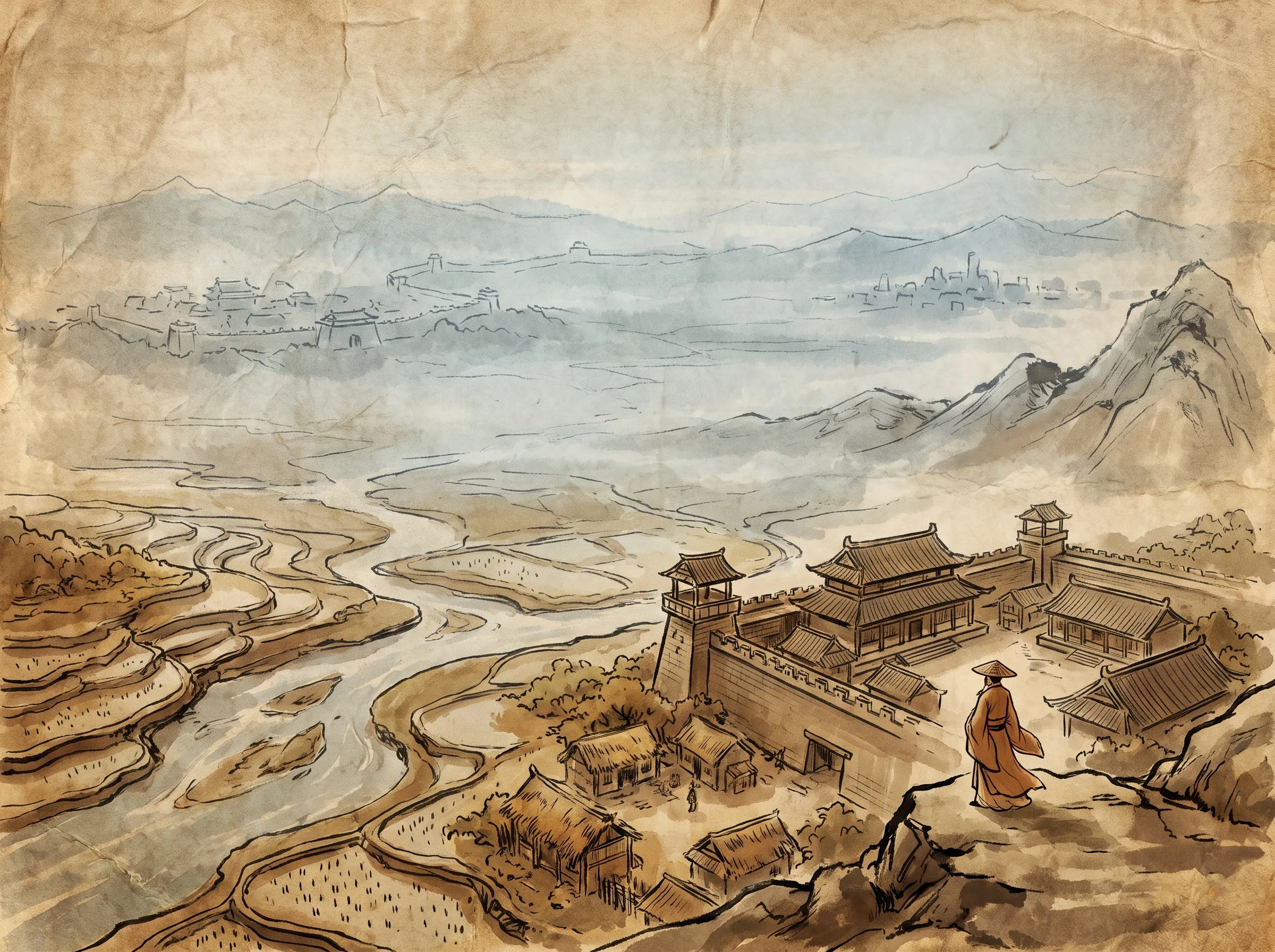
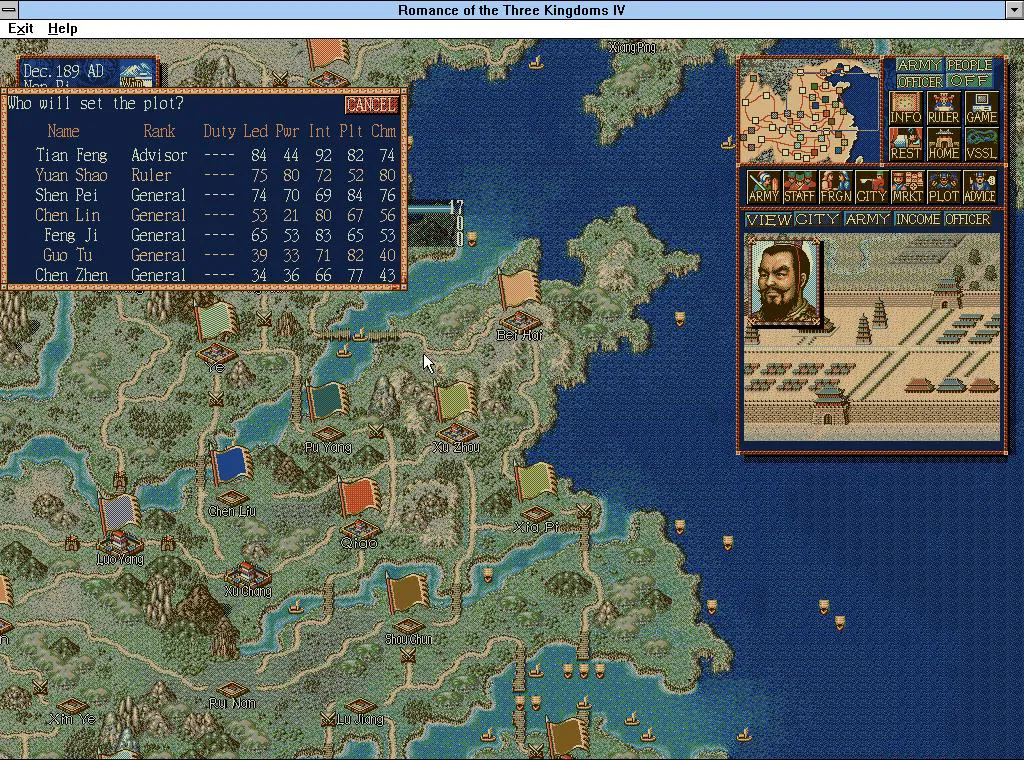
The first Romance of the Three Kingdoms game I played was Wall of Fire. ROTK IV, the PC version. It came out in 1995. I found it around 2003, years after anyone was supposed to care about it. The portrait art made every warlord look like he was about to recite a poem or start a war, sometimes both. I did not understand half the systems. I did not need to. The map was the entire Han empire, and every city on it was mine to take.
ROTK V never came out in English. VII and VIII eventually did, but only on PlayStation 2, in 2002 and 2003. I did not have a PS2. I had a PC. For three entries in a row, the series existed in a language or on a platform I could not reach.
ROTK IX and X had Japanese PC versions, and fan translation teams partially translated them. I played them with my grandfather's copy of the Thiều Chửu Hán-Việt Tự Điển beside me, a dictionary of Sino-Vietnamese character readings first published in Hanoi in 1942, 8,318 entries. I could not get the full meaning of most things. I found a character in the dictionary, guessed what the sentence probably meant from context, and moved on. Sometimes I spent ten minutes flipping pages for a single kanji that turned out to be a unit of measurement I did not need. But I started recognizing radicals, then compounds, then names. That is how I learned to read Chinese characters.
ROTK XI shipped in 2006 and arrived on English PC in September 2008. It was the best entry in the series. The Chinese modding community still plays it. The mod 血色衣冠 (Scarlet Garb) expanded the game to span two thousand years of Chinese history, forty factions, over seven hundred officers. Other mods followed: 逐鹿天地 (Contend for the Heavens), 大浪淘沙 (Sifting Gold). People are still modding XI because the sequels did not replace it.
ROTK XII never got an English release. XIII came back in 2016 and felt shallow. XIV in 2020 had a forty-one percent recommendation rate on Steam and shipped over thirty-five pounds of DLC within two months. Costume packs and scenario packs at expansion prices. The series had become a DLC engine.
I started wanting to build my own about ten years ago. Not because I thought I could do better than Koei at their peak. Because I wanted to play a game Koei would never make.
What Is Missing
Koei's games have a rhythm. You pick a faction. You select an action from a menu. You end your turn. The AI takes its turn. You pick another action from the same menu. Every character is a stat block: Charisma 14, Loyalty 73, a portrait. You interact with them through menus. Offer an alliance. Demand a title. After a hundred hours it feels the same.
I wanted characters with personality that you discover by talking to them. An open world you move through freely, not a list of actions you click through each turn. A battle that plays out on a field. The ability to be a nobody, a wanderer with no title, in a world that keeps going whether you act or not.
And I wanted the world to be bigger than the novel.
Koei's map covers China. Giao Châu, the commandery that covered most of what is now northern Vietnam, is a tile you can conquer. It has no characters, no events, no story. The Nanman are a single event chain. Japan does not exist. Korea barely does.
I wanted to play as a Vietnamese officer in Giao Châu, dealing with the chaos of a collapsing empire from the southern frontier. I wanted Funan to the south with its own agenda. I wanted Linyi, the Cham polity. I wanted the Sanhan confederacy in Korea. These are real polities that existed in 184 AD. Koei never included them because they fall outside the Romance of the Three Kingdoms novel. The novel is a Chinese story for a Chinese audience. The history is wider than that.
What the Game Is
Spoilers of the Three Kingdoms (Tam Quốc Tiết Mật Ký, 三國洩密記) is a grand strategy game crossed with a character-driven RPG. The campaign runs on a map of at least 229 cities across the Han empire and its neighbors. You move through it as a single character in an open world. You can pledge loyalty to a warlord, raise a warband, fight in battles, get captured, escape or serve your captor, trade, scheme, and talk.
The game starts in 184 AD, the year the Yellow Turban Rebellion breaks. It starts in Cửu Chân (九真), a commandery on the far southern edge of the empire. You are nobody important. The empire is falling apart to the north, and it will reach you soon enough.
Conversations
When you meet a character in Spoilers, you talk to them. Not through a dialogue tree, not through a menu. A local LLM generates what the character says based on who they are, what they know, what has happened between you, and the state of the world.
The model runs on my own hardware. No cloud, no network. The conversation pipeline has eight stages. A voice check keeps characters in period. A provincial officer does not speak like a court eunuch. A merchant does not speak like a general.
Conversations are the primary way you learn things. Rumor, loyalty, faction politics, the movements of nearby armies. A character who trusts you tells you more. A character who is lying tells you something that sounds true but leads somewhere wrong. None of it is scripted. None of it repeats. The game's title is literal: the "spoilers" are the stories the characters tell you, and every playthrough generates different ones.
The Two Readings
The Three Kingdoms is Chinese history. But the game opens in Vietnamese territory, and I am Vietnamese, and the game carries both readings.
Every proper noun has two forms: the Traditional Chinese characters and the Hán-Việt reading, the Vietnamese pronunciation of the same characters. Cửu Chân is 九真. Giao Châu is 交州. Tào Tháo is 曹操. Hán-Việt is not a translation. It is a system of Sino-Vietnamese pronunciation that has been in use for over a thousand years. The same system I picked up one character at a time from my grandfather's dictionary, guessing what Gia Cát Lượng was telling me about the weather in a Japanese game with no English.
Every city, character, and faction name in the game is authored with both readings. A build gate rejects any entry missing either one. The UI renders both: Hán-Việt as the primary label, Chinese characters as annotation.
The Research
My grandfather had a copy of the Đại Việt Sử Ký Toàn Thư on his shelf. Very long book. Very boring to a child. I read it anyway. It got me interested in Vietnamese history in a way that stayed. That interest and the love for the ROTK games are the two things this project grew out of.
The game draws on both Chinese and Vietnamese sources across about thirty topics. I wanted to know things like what a Han official's salary could actually buy, how fast armies moved between commanderies, and what diseases stopped campaigns before they started. The research covers the official records, but also folk history and unofficial accounts that the court historians left out, and a layer of legend: omens, named weapons, divination. Things people at the time believed were real.
Twenty-five fictional characters are placed in that researched world. Vietnamese, Cham, highland, Chinese backgrounds. People who could have existed in 184 AD but who the novel never mentioned.
A future entry in this series will go into the research and the content pipeline in detail.
This Series
This is the first entry in a development diary. Regular posts about what is being built, why the decisions were made, and how things work.
Coming up: the LLM conversation pipeline. The campaign map. The content pipeline. The battle system.
Mochi Nguyen writes about the work on veritart.me.
Comments (0)
No comments yet. Be the first to share your thoughts.