
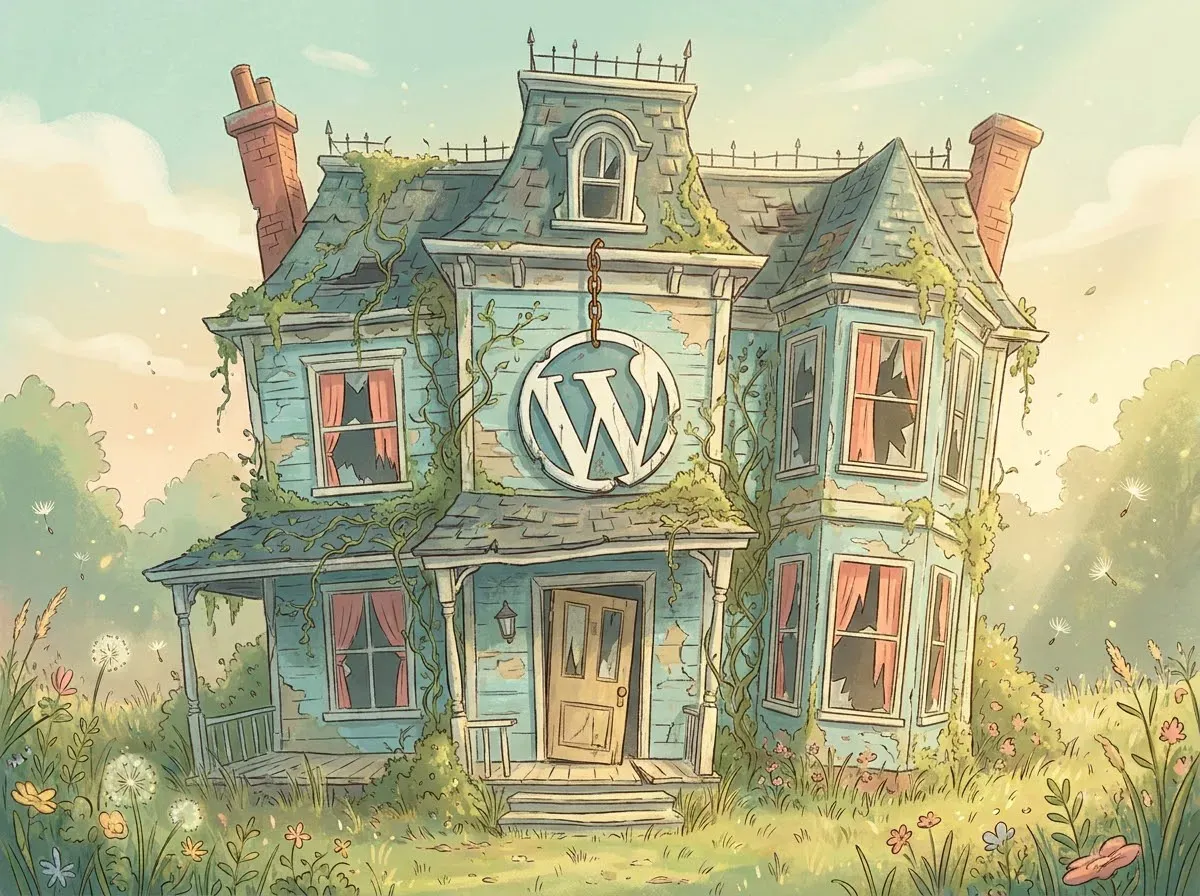
In 2009 the family business needed a website. I was the closest thing we had to an IT department.
I tried the platforms of the day. Magento was enterprise machinery. It wanted a developer, a real server, and a budget with a comma in it. Joomla was the serious choice, and it felt like one. Its learning curve was shaped like a wall.
WordPress wanted almost nothing. My host already had a button for it. I clicked the button, and the family business was online.
The button was half the reason. The other half was better: whatever the site needed next, somebody had already built it. That January the plugin directory crossed four thousand plugins [1]. The theme directory held seventeen hundred vetted designs, free, one click away. A shop template to look respectable, a contact form, whatever came up. Built, waiting.
WordPress wasn't even winning in 2009. The Water & Stone open source CMS survey [2] that year put Joomla ahead in actual usage, by six and a half points. WordPress led in exactly one category: people liked it.
I didn't pick a monopoly. I picked the one that was nice to me. So did everyone else, one lazy afternoon at a time, and that's where 43% of the web came from [3].
This article is an obituary, which is a strange thing to write about software that still runs two of every five websites. But the thing that died isn't the software. It's the default: the thing you start with because starting anywhere else takes a reason.
Nobody outside killed it. The leadership spent eight years forcing things users said no to, then burned the community's trust in public, and AI arrived at the exact moment nobody was left who wanted to defend the place.
Every wound self-inflicted. Every instrument played from inside the house.
Learn JavaScript, Deeply
The roadmap was never up for a vote, and in December 2015 the community found out.
Matt Mullenweg, who co-founded WordPress in 2003 and still runs the project, stood on stage at State of the Word, the annual keynote, and assigned everyone homework: "Learn JavaScript, deeply [4]." The people who had spent a decade building the ecosystem in PHP heard it correctly. The future had been decided, and it wasn't theirs.
The future had a name: Gutenberg, a React-based block editor, named without apparent irony after the man who democratized publishing.
What does a community do when the roadmap isn't up for a vote? It waits for the first chance to answer, and in August 2018 it got one. WordPress 4.9.8 pushed a "Try Gutenberg" prompt into millions of dashboards. Beta software, offered to everyone, on live sites. The feedback came back at the speed of a star rating. Before the prompt, the Gutenberg plugin sat at a mediocre 2.7 stars [5]. A week later it was 2.4.
Something else moved faster. The Classic Editor plugin, the official way to keep the old interface, went from 7,000 installs to over 60,000 in days [5]. Sixty thousand people installing the off switch is a vote, and it was the only vote on offer: one star, and one exit, at a time.
The Reviews Were In
Then the accessibility team lead quit.
Rian Rietveld had spent years making WordPress usable for people with screen readers. On October 9, 2018, she resigned and said why in public. The new codebase, she wrote, "is difficult for all of us, because no one in the wpa11y team is a skilled React developer [6]." Fixes her team fought for got approved, then overwritten by later commits, "breaking the a11y improvements again [6]" (a11y is the trade's shorthand for accessibility). One test round surfaced so many problems that "most testers refused to look at Gutenberg again [6]."
There was supposed to be an independent accessibility audit. Automattic, Mullenweg's company and the biggest contributor to the project, skipped it, citing the timeline. A community of university web workers set out to crowdfund the $31,200 audit themselves [7]. They raised $10,264, and Mullenweg agreed to cover the rest. The auditors came back in 2019 with "significant and pervasive accessibility problems [7], the likes of which amount to a step backwards for users with disabilities over the legacy editor."
The release they audited had already shipped, because it was always going to ship.
Joost de Valk, who built the most installed SEO plugin in the ecosystem, had written it plainly a month before: "we are setting ourselves up for failure [5]." A core committer put it flatter in the dev chat: "I do not see how we can seriously ship a release candidate today [5]." On December 4, 2018, the project announced WordPress 5.0 would ship December 6 [5]. Three days' notice, in the holiday code-freeze season, and WordCamp US, or WCUS, the project's biggest conference of the year, began December 7. The keynote had a launch to celebrate.
On stage, Mullenweg explained the timing: "We were scared to announce a new release date [8] after missing our previous one." The calendar scared him. The reviews didn't.
To the developers patching client sites from airport lounges, he offered this: "I do not think the attendees of WCUS are more important [8] than [the] much larger portion of the WordPress community who does not (and cannot) attend." I've read that sentence a few times and I still can't find the part where the larger portion asked for a December release. De Valk called the decision "irresponsible and disrespectful towards the community [5]." It held.
The No Vote
WordPress offered one concession: an official plugin to turn the new editor off. The promise, in writing, November 2018, was that the Classic Editor would be "officially supported until December 31, 2021 [9]." That deadline came and went. The promise was extended. Today the plugin's own page says it will be supported "until 2024, or as long as is necessary [9]." The deadline inside that sentence has also expired, so "as long as is necessary" is now carrying the whole load.
How much load? You can check both pages yourself. They're live on wordpress.org.
The escape hatch. The Classic Editor has over eight million active installs [9] and a 4.9-star rating: 1,185 five-star reviews against 16 one-star. It's one of the most installed plugins in existence, and its entire function is to remove the flagship feature.
The flagship. The Gutenberg plugin's page, seven years and hundreds of releases later, shows 2.1 stars: 2,491 one-star reviews against 869 five-star [10].
Both pages have looked like that for years.
The escape hatch vs the flagship
Two wordpress.org plugin pages, both live today — every metric inverted
Some people left entirely. In August 2018, before 5.0 even shipped, a developer named Scott Bowler forked WordPress into ClassicPress: "After my feedback on Gutenberg fell on deaf ears [11] I realized that WordPress is no longer a community led project." The rest of his sentence: "major decisions are being made by an elite few." ClassicPress still exists. Its last published count, in 2021, was about 1,500 sites [11]. The anger was real. Forking wasn't the escape, and the reason matters.
A fork copies the code. It doesn't copy the plugin directory, the theme directory, the update server every install phones home to, or the trademark that lets you call the result WordPress. All of those sit under one man. Mullenweg controls the WordPress trademark: it lives in a foundation he founded, and his company holds the commercial license. He owns wordpress.org, the site with the directories and the update server, personally. And he runs Automattic, the commercial company that sells WordPress hosting. The community had spent fifteen years contributing to what it thought was a commons, and had just learned it was a tenant.
The tagline says "democratize publishing." The org chart says monarchy. It took six more years for the org chart to prove it.
The Cancer Post
September 20, 2024, and Mullenweg is closing WordCamp US. Instead of a keynote he goes after WP Engine from the stage. WP Engine is one of the biggest WordPress hosting companies, and a direct competitor of Automattic's own hosting. A "bad actor." A "bully." Profiting from the ecosystem, giving too little back. He tells the audience to move their sites elsewhere.
The same day, someone at Automattic dated a term sheet. It offered WP Engine a license to the WordPress trademark for 8% of its gross revenue, monthly, for seven years [12], auto-renewing. Gross, not profit: 8% of every dollar customers pay, before servers and staff. On industry estimates of WP Engine's revenue, that's roughly $32 million a year. The speech and the invoice share a date. I keep coming back to that.
The famous word came the next day, in writing: "they're giving you a cheap knock-off and charging you more for it. This is one of the many reasons they are a cancer to WordPress [13], and it's important to remember that unchecked, cancer will spread." He didn't blurt that into a microphone. He wrote it, edited it, and published it on wordpress.org's official blog, the one every WordPress dashboard links to. The same post counted WP Engine's footprint at one and a half million websites [13]. His count, nobody else's.
Hostages
Five days after the keynote, wordpress.org published a post titled "WP Engine is banned from WordPress.org [14]."
The ban worked like this. Every WordPress site checks wordpress.org several times a day for plugin, theme, and core updates. Block the servers a hosting company runs [14], and every site on those servers stops seeing updates, security patches included. The ban didn't touch WP Engine's executives. It cut off the one and a half million sites he'd just counted, businesses whose only crime was a hosting invoice. If you ran a site on WP Engine that week, your security updates stopped and nobody asked you.
Two days later came a reprieve until October 1, with a taunt attached: hopefully this helps them spin up mirrors of everything "they were using for free while not paying."
Inside Automattic, Mullenweg offered dissenters a door: $30,000 or six months of salary, whichever is higher, if you leave by Thursday. 159 people took it [15]. That's 8.4% of the company, and by his own published breakdown, 79.2% of them from the WordPress side of the business. The WordPress people left the WordPress company.
On October 9, a new checkbox appeared on the wordpress.org login page: "I am not affiliated with WP Engine in any way [16], financially or otherwise." A loyalty oath, to log into an open source project. I still think it's the strangest artifact of the whole war. Contributors who asked in the project Slack what "or otherwise" meant found their accounts deactivated.
On October 12 came the escalation nobody had a category for. Mullenweg took Advanced Custom Fields, a plugin installed on two million sites [17], built and owned by WP Engine. wordpress.org took over its listing, rerouted its updates, and renamed it "Secure Custom Fields." Mullenweg's justification invoked "point 18" of the directory guidelines and allowed that "similar situations have happened before, but not at this scale [17]." WP Engine's version: in 21 years, no actively maintained plugin had ever been taken [17] from its creator without consent.
Go back to 2009 for a second. The reason we all chose WordPress was that somebody had already built it. October 12, 2024 was the day everyone learned that what somebody built could be confiscated.
The Court Order
On December 10, 2024, a federal judge granted WP Engine a preliminary injunction [18]: restore the access, remove the checkbox, give the plugin back, seventy-two hours. It took a United States court order to get a competitor's customers their updates back.
Ten days later, wordpress.org announced a "holiday break." New account registrations, paused. New plugin submissions, paused. Reviews, theme submissions, paused. The stated reasoning included that he was "legally compelled to provide free labor [19] and services to WP Engine thanks to the success of their expensive lawyers."
In January, Automattic cut its sponsored contributions to WordPress core to about 45 hours a week [20]. The announcement said, in its own words, that it was matching the pledge made by WP Engine. Reporters who checked the project's own pledge dashboard put the old figure near 4,000.
Why does one company's hours matter to a project with hundreds of contributors? Because of how concentrated the work is. In WordPress 6.6, the quarter of contributors sponsored by companies received three quarters of the credit, and Automattic alone accounted for 3,562 contributions [20]. When one company is that much of the engine, its tantrum is a governance event, whatever the org chart says.
The same month, five prominent community members, including de Valk, had their wordpress.org accounts deactivated. De Valk's offense was proposing governance reform, a board instead of a throne. Mullenweg framed the deactivations as a favor: "To make this easy and hopefully give this project the push it needs to get off the ground, I'm deactivating the .org accounts of..." De Valk had never proposed a fork, and said so.
In April 2025, Automattic laid off about 281 people, 16% of the company [21]. No warning. Locked out of Slack the same morning.
I'll give Mullenweg this much: WP Engine is owned by private equity, the free-riding complaint had a kernel of truth in it, and none of this makes them a martyr. He had a case. He chose to make it with hostages.
Deaf Ears
The WP Engine war looks like a break. It wasn't. The pattern goes back to 2017, a year before the prompt that cratered the rating, when Mullenweg published a post titled "We called it Gutenberg for a reason." His answer to the criticism already building: "Creating great software will never make every person happy. Let's push through the fear together [28]."
At WordCamp Portland in November 2018, a month before the forced 5.0 ship, he addressed the backlash directly: "people tend to read the worst into things that have been said [29]." After the December ship, he wrote on his own blog why waiting longer was not an option: "Gutenberg is the basis for other developers to build on. Being in core was an important next step [30]."
Push through the fear. People read the worst. An important next step. The rating, the sixty thousand installs of the off switch, the resignation, the audit, the reviews: none of it changed the direction by a degree.
The pattern kept running after the lawsuits.
In December 2024, the same month as the court order, a community Sustainability team was dissolved. "Today I learned that we have a sustainability team [31]," Mullenweg posted. Hundreds signed a petition at WCEU. Leadership declined to reinstate it.
In April 2026, he overruled his own core committers on an Akismet integration decision for WordPress 7.0. The Trac ticket had been open for thirty-six minutes. "I did say that, and have changed my mind and we're doing this [32]." Multiple committers flagged the process bypass. It shipped. The same month he called the Five for the Future contribution program "worse than useless [33]," the same program that had asked hosting companies to contribute 5% of their resources to WordPress, and from which he'd cut Automattic's own share to forty-five hours a week three months earlier.
Then August 2026. The accessibility team, the one Rietveld built and left, posted about extending a deadline for theme reviews. Mullenweg replied in the comments of their own blog post: "Actually, this is permanently delayed. The team has overstepped its authority, usefulness, and charter [34]." His next sentence: "Going forward, any other team or committer can override suggestions or requests from current accessibility team members [34]."
Eight years earlier, Rietveld quit because her team's accessibility fixes kept getting overwritten by later commits. In 2026, overwriting them became the stated policy.
The Tunnel
The community did try to save itself. That story is short, and it's the one I find hardest to forgive, and the fault isn't Mullenweg's.
In June 2025, ecosystem veterans launched FAIR under the Linux Foundation. The idea was simple. Instead of every site phoning home to one server that one man owns, sites could pull plugins and updates from any of several independent mirrors. Ban a host from one, and nothing happens. No plugin, no update, no developer would ever again depend on one man's mood. It worked. The software shipped.
In February 2026, its leaders quit the WordPress effort. Why would a hosting company not fund an escape route from its own supplier? De Valk answered in his own post. Not because they loved the status quo, he wrote. Because investment "means commitment. It means cost. It means stepping into political tension. And most of all, it means risk." The tunnel was finished, lit, and safe, and nobody with money wanted the political tension of walking through it. FAIR packed up and pointed its technology at a different CMS entirely.
You can't federate your way out of a monarchy. You can only leave the kingdom.
The Moat
Leaving needed somewhere to go, and for twenty years there wasn't one.
WordPress ran on one sentence: you don't have to build a CMS. The themes, the plugins, the PHP baggage, the update roulette, all of it was the price of not building one, and the price was worth paying because building your own cost a team and a year. The roulette has a number now. Patchstack counted 11,334 new vulnerabilities [22] in the WordPress ecosystem in 2025, up 42% on the year, 91% of them in plugins. For the ones attackers went after hardest, the median gap between disclosure and first exploit was five hours. That's what you were buying when you chose not to build: somebody else's plugin, somebody else's patch schedule, and a five-hour window.
In 2026 the price flipped. Describe the CMS you want to an AI agent and it builds that one, without the twenty years of baggage, in less time than it used to take to evaluate themes.
The numbers moved quietly, and you have to know how they're counted to see what moved. W3Techs, the ruler everyone quotes, samples the ten million most visited sites and asks what each one runs. By that ruler WordPress peaked at 43.6% of the web [3] on the first day of 2025, was 43.0% on the first day of 2026, and reads 40.7% this September [3]. Other rulers disagree about the height. The absolute count of WordPress sites still grows, and stricter, traffic-weighted counts put its share of the web people actually visit closer to a third. Every ruler agrees on the direction.
The default erodes
WordPress share of the top 10M sites · W3Techs
Show the figures
| Date | Market share |
|---|---|
| 2020 | 38.5% |
| 2022 | 42% |
| Jan 2025 (peak) | 43.6% |
| Jan 2026 | 43% |
| Sep 2026 (now) | 40.7% |
And nobody is fleeing. That's the honest part, and it's the part the doom pieces skip. Migrations are expensive, old sites are sticky, and no one can prove a single site left over the drama. What collapsed is the choosing. The web adds sites every year, so the denominator grows, and if new sites stop starting on WordPress the share falls while the site count rises. My reading of who stopped: the scandals froze the enterprise pitch, prompt-to-website builders took the low end, and AI agents took the ceiling. The share isn't shrinking so much as diluting, and dilution is exactly how it grew. Nobody "switched" to WordPress in 2009 either. We just started there.
Pennies
WordPress noticed. Automattic's answer is Telex, an experiment that turns plain-English prompts into Gutenberg blocks. Mullenweg describes it as "V0 or Lovable, but specifically for WordPress." The company that spent 2018 forcing blocks on writers now sells the tool that generates blocks for what Mullenweg, at State of the Word last December, priced at "pennies."
The plugin directory noticed too, in its own way. Submissions to wordpress.org averaged 150 a week in 2024 [35]. By June 2026 they were near 700 a week, and the review queue peaked around 1,050 in April. Of the plugins reviewed in 2025, 38.7% never got a reply from their own authors [35]. In 2009 the directory was the reason to choose WordPress: four thousand things somebody had built and would look after. In 2026 it takes in five times the submissions, and nearly four in ten submitters don't answer their own review.
WordPress 7.0 itself shipped this May, late. Twelve days before launch, Mullenweg personally pulled its flagship feature [23], the Google-Docs-style collaboration users had waited years for, citing "recurring bugs found through fuzz testing." What shipped instead was AI plumbing: a native AI Client and an Abilities API, the groundwork for what Automattic's own blog now calls "the operating system of the agentic web [24]." A point-one release fixed 31 bugs in July. Point-four arrived in August.
Eight years after Gutenberg, it's the same movie: the thing users asked for slips, and the strategic pivot ships.
Leaving the Kingdom
Leaving by building isn't new. It used to be expensive. John O'Nolan was a former deputy lead of the WordPress user interface team when he put a publishing platform of his own on Kickstarter in April 2013. It asked for £25,000, was funded in eleven hours, and closed at £196,362 [25]. Then it took a team and years to become Ghost, which is where 404 Media and Platformer live today [26]. That was the old price of walking out of the kingdom with your own roof: a public fundraise and a decade.
De Valk tried to leave without walking. His Yoast SEO plugin sits on ten million WordPress sites [27], and he spent 2025 helping build FAIR so the kingdom could keep its subjects and lose its king. He'd already lost his wordpress.org account for proposing a board. Then the hosts wouldn't fund the tunnel, and he took the technology to TYPO3.
Then there's the price in 2026.
I ran my own sites on WordPress for years, and I'd disliked the editor since Gutenberg. Not for the reasons in the one-star reviews. Mine was smaller and more stubborn: Gutenberg is a copy of Medium's editor, and WordPress isn't Medium. Every paragraph became its own block, with its own toolbar and its own opinion about where it wanted to sit, and drafting, the one thing I open a CMS to do, got slower. The scandals settled whatever trust was left. The installs had grown bloated and slow under me, the way they all do. And underneath all of that: I wanted total control of my own CMS, and for the first time in my life that sentence didn't sound expensive.
So I built one. Plinth. Me and an AI agent, five days to a fully working CMS, written in TypeScript with no runtime dependencies at all. The database is the one that ships with Node. Then I exported every article from my two WordPress sites, imported them into Plinth, pointed the domains at the new host, and abandoned the old WordPress one. No migration plugin, no agency, no quote with a comma in it. The rest of my WordPress sites are queued to follow.
Veritart, the site you're reading right now, never ran on WordPress. It's new, and Plinth was the default it started on. It's still growing, because a finished CMS is somebody else's CMS. Search and the redirects from the old URLs are files I can open, and when a site needs something Plinth doesn't do, I change it that afternoon.
I'm a developer, so discount me accordingly. The 2009 version of me, the kid clicking his host's install button, could not have done this. But the point is the direction of the curve. In 2009, your own CMS cost a company. In 2026 it cost me five days, and the discount you should apply to my story shrinks every quarter.
I wrote earlier in this series that the best way to rank in Google is to not need Google. Same rule, different landlord. These words arrived through Plinth. The article about leaving WordPress is being served to you by the thing I built to leave it.
The Easy Choice
WordPress isn't going to vanish. Two of every five websites is a lot of inertia, and the software will outlive this obituary comfortably. The enterprise arm is where the energy went. This January, WordPress VIP shipped the collaboration feature that the open source core pulled in May. The paid product delivered what the commons couldn't.
So WordPress isn't dying as software. It's dying as a default, moving upmarket into an enterprise product, and for a project whose tagline is "democratize publishing," that is its own kind of obituary.
In 2009 I chose WordPress because it didn't make me fight. It was easy to start, my host blessed it, and whatever I needed, somebody had already built it. Millions of people made the same unremarkable choice, and their unremarkable choices compounded into the biggest platform the web has ever had.
In 2026 people are still choosing exactly the way I did back then. Least resistance. Blessed by the tools they already have. Built before they finish asking.
Nobody killed the easy choice. WordPress just stopped being it.
References
- WordPress.org. (2009). Plugin directory. https://wordpress.org/plugins/
- Water & Stone. (2009). 2009 Open Source CMS Market Share Report. Water & Stone.
- W3Techs. (2026). Usage statistics and market share of WordPress. W3Techs. https://w3techs.com/technologies/details/cm-wordpress
- Mullenweg, M. (2015, December 5). State of the Word 2015 [Keynote]. WordCamp US, Philadelphia.
- WP Tavern. (2018, August 7). Gutenberg plugin review stats and Classic Editor surge. WP Tavern. https://wptavern.com/
- Rietveld, R. (2018, October 9). I have resigned as the WordPress accessibility team lead. rianrietveld.com. https://rianrietveld.com/2018/10/09/i-have-resigned-the-wordpress-accessibility-team/
- WPCampus. (2019). WPCampus Gutenberg accessibility audit. WPCampus. https://wpcampus.org/2019/05/gutenberg-audit-results/
- Mullenweg, M. (2018, December 7). State of the Word 2018 [Keynote]. WordCamp US, Nashville.
- WordPress.org. (2026). Classic Editor plugin page. https://wordpress.org/plugins/classic-editor/
- WordPress.org. (2026). Gutenberg plugin page. https://wordpress.org/plugins/gutenberg/
- ClassicPress. (2018). About ClassicPress. https://www.classicpress.net/
- Automattic. (2024, September 20). WordPress trademark license term sheet. https://automattic.com/2024/wp-engine-term-sheet.pdf
- Mullenweg, M. (2024, September 21). WP Engine is not WordPress. WordPress.org News. https://wordpress.org/news/2024/09/wp-engine/
- WordPress.org. (2024, September 25). WP Engine is banned from WordPress.org. WordPress.org News. https://wordpress.org/news/2024/09/wp-engine-banned/
- Mullenweg, M. (2024, October 3). Alignment. ma.tt. https://ma.tt/2024/10/alignment/
- 404 Media. (2024, October 9). WordPress.org login checkbox. 404 Media.
- WordPress.org. (2024, October 12). Secure Custom Fields. WordPress.org News. https://wordpress.org/news/2024/10/secure-custom-fields/
- U.S. District Court, N.D. Cal. (2024, December 10). WP Engine v. Automattic, preliminary injunction order. Judge Araceli Martínez-Olguín.
- WordPress.org. (2024, December 20). Holiday break announcement. WordPress.org News.
- WordPress.org. (2025, January). Automattic contributions update; WordPress contributor pledge dashboard. https://wordpress.org/five-for-the-future/
- Automattic. (2025, April). Company restructuring announcement.
- Patchstack. (2025). State of WordPress Security 2025. Patchstack. https://patchstack.com/whitepaper/state-of-wordpress-security-in-2025/
- annezazu. (2026, May 8). Real-time collaboration will not ship in WordPress 7.0. Make WordPress Core. https://make.wordpress.org/core/2026/05/08/rtc-removed-from-7-0/
- Automattic. (2026, April 21). WordPress: The operating system of the agentic web. Automattic Blog.
- Wikipedia contributors. (2026). Ghost (blogging platform). Wikipedia. https://en.wikipedia.org/wiki/Ghost_(blogging_platform)
- Ghost. (2026). Publishers on Ghost. Ghost.org. https://ghost.org/publishers/
- WordPress.org API. (2026, September 3). Yoast SEO plugin info. https://api.wordpress.org/plugins/info/1.0/wordpress-seo.json
- Mullenweg, M. (2017, August 27). We called it Gutenberg for a reason. ma.tt. https://ma.tt/2017/08/we-called-it-gutenberg-for-a-reason/
- WP Tavern. (2018, November). Matt Mullenweg addresses controversies surrounding Gutenberg at WordCamp Portland Q&A. https://wptavern.com/matt-mullenweg-addresses-controversies-surrounding-gutenberg-at-wordcamp-portland-qa
- Mullenweg, M. (2018, December 14). State of the Word 2018 [comment]. ma.tt. https://ma.tt/2018/12/state-of-the-word-2018/
- The Repository. (2024, December). Mullenweg shuts down WordPress Sustainability Team. https://www.therepository.email/mullenweg-shuts-down-wordpress-sustainability-team-igniting-backlash
- The Repository. (2026, April). Matt Mullenweg overrules core committers to put Akismet on WordPress 7.0. https://www.therepository.email/matt-mullenweg-overrules-core-committers-to-put-akismet-on-wordpress-7-0s-connectors-screen
- The Repository. (2026, April). Mullenweg calls Five for the Future data "worse than useless". https://www.therepository.email/matt-mullenweg-calls-for-rethink-on-wordpress-contributions-says-five-for-the-future-data-is-worse-than-useless
- Mullenweg, M. (2026, August 1). Comment on Accessibility Ready theme reviews: extending the deadline. Make WordPress Accessibility. https://make.wordpress.org/accessibility/2026/07/23/accessibility-ready-theme-reviews-extending-the-deadline/
- WordPress.org. (2026). Plugin review team reports and submission statistics. make.wordpress.org/plugins.
Mochi Nguyen writes about AI, product development, and where technology meets content strategy.
Comments (0)
No comments yet. Be the first to share your thoughts.