 Skip to content

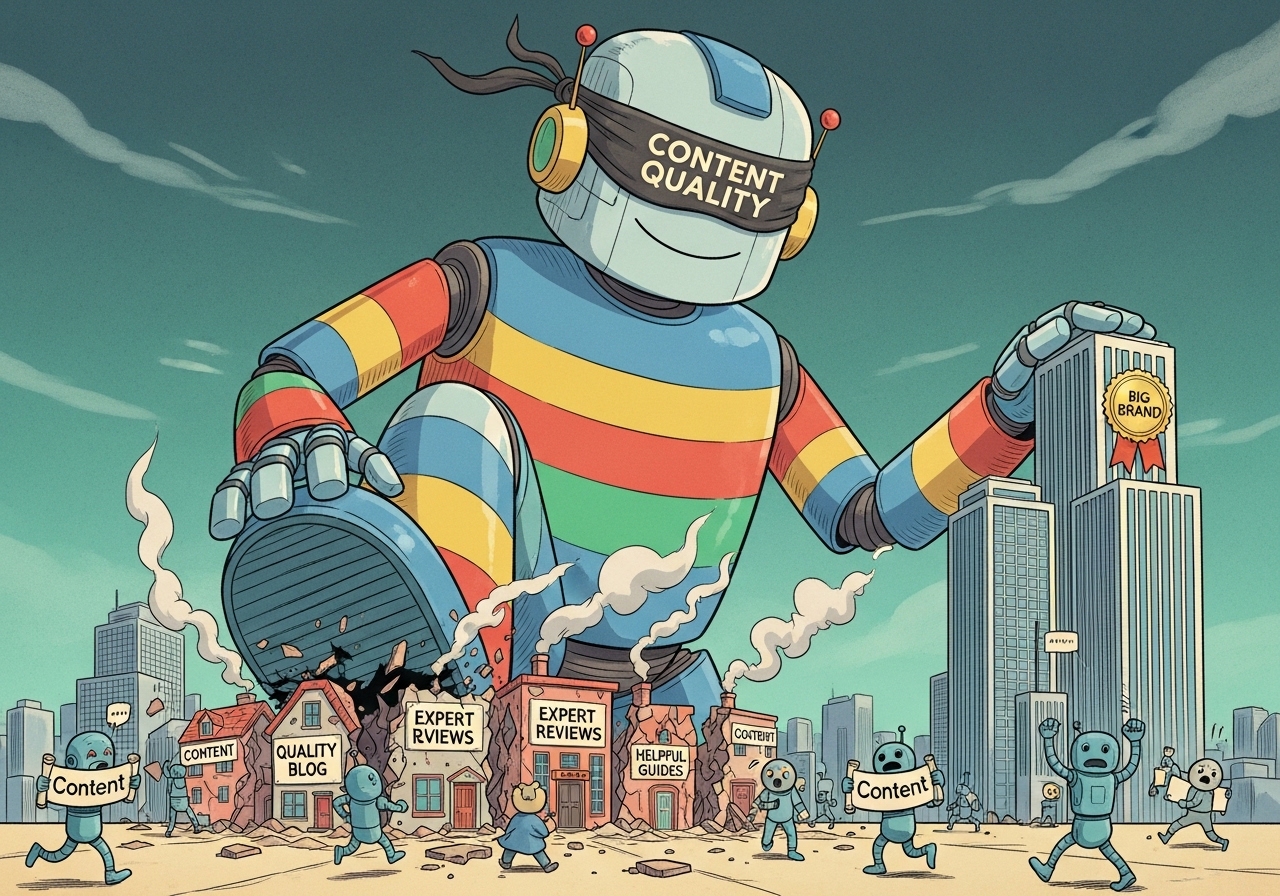
September 12, 2025. I woke up and watched my experiment die.
A question had nagged at me for years: Can a website actually rank on Google by doing everything right? Pure white-hat SEO. Quality content only. No backlink schemes, no link buying, no gray-hat tactics. Just social media profiles and whatever natural links the content earned on its own.
I'd never had the chance to test it properly. Then in 2024, I quit my job. Suddenly I had time. So I ran the experiment.
I wanted to see if Google's official advice actually worked. "Focus on creating helpful, reliable, people-first content." That's what they said. I took them at their word.
I'm still not sure if that was naivety or optimism. Probably both.
Six months in: 100 articles. All original. All researched. Traffic started climbing.
One year in: over 10,000 monthly visitors. Charts looked beautiful. Growth was consistent. The experiment was working.
Then I woke up and checked analytics. The line didn't dip. It fell off a cliff. Peak traffic to nearly zero. Overnight.
I refreshed three times thinking it was a bug. It wasn't.
The rise & the fall
Daily organic clicks from Google Search
Show the monthly figures
| Month | Clicks | Impressions |
|---|---|---|
| Feb 2025 | 13 | 3,867 |
| Mar 2025 | 212 | 28,199 |
| Apr 2025 | 561 | 58,318 |
| May 2025 | 943 | 98,418 |
| Jun 2025 | 1,632 | 164,076 |
| Jul 2025 | 4,463 | 416,169 |
| Aug 2025 | 6,992 | 582,096 |
| Sep 2025 | 2,634 | 248,699 |
| Oct 2025 | 258 | 42,262 |
| Nov 2025 | 181 | 85,806 |
| Dec 2025 | 167 | 86,264 |
Reddit's r/SEO was already on fire. "Huge Traffic Drop From Friday, Sep 12 to Saturday, Sep 13." "Organic Traffic dropped 30-50%, same for you all?" One guy in Asia said all his client sites got hit.
Google had been rolling out their August 2025 Spam Update. MozCast hit 123.4 degrees that week. Anything above 100 is major turbulence. Google's Liz Reid said they "broadened their definition of spam."
Broadened. One word for it.
My traffic never recovered. Competitors kept growing. Their orange line climbing while my blue line flatlined at zero.
The experiment answered my question. Just not the way I expected.
You can do everything Google tells you to do. You can follow every guideline, create genuinely helpful content, play by every rule. And it doesn't matter. Because the rules they publish aren't the rules they enforce.
This wasn't Google getting smarter about AI content. This was Google giving up on content analysis entirely and retreating to a safe list of brands they already trusted.
I just wasn't on it.
The Comforting Lie
The narrative the SEO industry tells itself:
Google's Helpful Content Update worked. AI content got penalized. Human-written, expert content rose to the top. Quality won. The system works.
Reboot Online tracked 68 websites across 20 industries for eight months. Human-written content received 5.44 times more organic traffic than AI-generated content.[1] NerdWallet lost $6.9 million in organic traffic value. TechRadar saw significant declines.
See? The system works. Quality won. Go back to sleep.
Except Google didn't figure out anything.
What actually happened: Google stopped trying to evaluate content quality and started evaluating entity credibility instead. They didn't build a better AI detector. They built a brand verification system.
The algorithm now treats sites as untrustworthy by default unless they possess overwhelming off-page signals connecting them to a known, verifiable real-world entity. Wikipedia pages. Knowledge Panels. Press mentions from major publications. The signals that big brands have and independent creators don't.
In the eyes of the algorithm, an anonymous expert is indistinguishable from an AI content farm.
The Disconnected Entity
There's a theory in SEO circles called the "Disconnected Entity Hypothesis." It explains everything I experienced.
Google's systems determine trust not by the content on the page, but by the entity's connection to the wider Knowledge Graph. A site is "disconnected" if it lacks clear, machine-readable associations with other verified entities—authors, organizations, physical locations.
If your site exists as an island without bridges to the mainland of trusted media, you're devalued. Doesn't matter how good your content is.
Mike Hardaker ran Mountain Weekly News for over a decade. Legitimate news coverage. Real journalism. The year before the updates, he grossed $250,000.
After? Down 97%. At the Google Web Creator Summit in October 2024, he testified he was eating at food banks.[2] A man who'd built a decade of journalism, standing in line for canned goods.
His content didn't change. His expertise didn't vanish. He just lacked the backlink profile of the New York Times. In Google's new system, that made him indistinguishable from spam.
DMARGE, an Australian lifestyle publication, dropped from 8 million monthly visitors to 300,000. They eventually recovered—after spending approximately $200,000 on technical SEO, content pruning, and brand rehabilitation.[3]
Quarter million dollars. That's the entry fee now.
Wiped off the map
Organic traffic lost after Google's core updates
If recovery requires that kind of capital injection, the search ecosystem has become pay-to-play. Small publishers aren't eliminated because their content is bad. They're eliminated because they can't afford the signals required to prove it's good.
The HouseFresh Illusion
HouseFresh was supposed to be the redemption story.
Small independent review site. Rigorous physical testing of air purifiers. Lab photos. Filtration data. Videos of the testing process. The archetype of what Google claimed to want.
In September 2023, they lost 95% of traffic. Their rankings were taken by Better Homes & Gardens, PopSci, Forbes—sites using stock photography and summarizing specs without touching the products.
In February 2024, HouseFresh published "How Google is Killing Independent Sites."[4] The article went viral. BBC covered it. The Verge. SEO Roundtable. It became the rallying cry for the small web.
In October 2025, HouseFresh announced a recovery that exceeded pre-HCU levels. Here's what Gisele Navarro, HouseFresh's co-founder, actually said: "hard work and a lot of luck." They didn't fundamentally change their content strategy. They were doing the right thing all along.
So what changed?
By complaining about Google, they inadvertently created the very Entity Signals that the algorithm required to trust them. The viral article generated massive backlinks from BBC, The Verge, major tech publications. Brand searches for "HouseFresh" spiked. They transitioned from a Disconnected Entity to a Known Entity—not through better content, but through a PR firestorm.
Sites that wrote similar quality reviews but didn't go viral? Still suppressed.
Google didn't fix the algorithm to detect better reviews. The algorithm "fixed" itself because HouseFresh became famous enough to register on Google's entity radar.
That's not a quality filter. That's a celebrity filter.
The Gray Hat Winners
While independent human creators got decimated, a specific class of AI-driven operations thrived.
Google's "Scaled Content Abuse" policy was supposed to stop programmatic SEO and mass-generated pages. Enforcement has been highly selective.
KrispCall, a SaaS provider, used programmatic SEO to generate thousands of area-code-based landing pages. Templated. Data-driven. AI-assisted descriptions. The result? 1,969% year-over-year growth.[5] 82% of US traffic from these programmatic pages.
Why weren't they penalized? They're a verified business entity with a functional software product. Strong E-E-A-T signals (Experience, Expertise, Authoritativeness, Trust—Google's quality framework). Their programmatic content gets classified as "utility." A niche blog doing the exact same thing gets classified as "spam."
Same content. Different host. Different outcome. If you're wondering whether the rules apply equally—they don't. They never did.
Forbes Advisor got hit with a manual action in September 2024 for reputation abuse—basically operating as an affiliate engine under the Forbes domain. Nearly 20 million monthly visits wiped out.[6]
Then it recovered. Not by changing the business model. By better integrating the affiliate content with the main brand. Tighter design. Better internal linking. Making the parasite look more like the host.
The "Site Reputation Abuse" policy didn't eliminate spam on authoritative domains. It incentivized better camouflage.
The most successful AI content operations now use "Gray Hat" workflows. AI generates outlines and drafts. Low-cost editors add "experience markers"—"In our testing," "I found that." Content gets wrapped in robust Schema markup. Attributed to "real" authors with LinkedIn profiles, even if their contribution was minimal.
Google's classifiers can't distinguish this from fully human-written content. The signals—structure, schema, authorship—mimic quality perfectly. The soul of the writing may be absent, but the metadata of quality is present.
And the algorithm reads metadata better than it reads prose.
Google can't detect AI. Nobody can—not reliably. The detection tools that universities and platforms depend on have false positive rates that destroy innocent people while letting actual AI content slip through. It's a fundamentally unsolvable problem: as AI improves, it converges on "good writing," becoming statistically indistinguishable from skilled human writers.
Google knows this. That's why they quietly shifted their guidance from "written by humans" to "helpful content created for people." They stopped trying to detect AI and started asking a different question: not "who wrote this?" but "can we trust the source?"
That question leads us to the real scandal—not AI, but the decade of lies Google told about how their algorithm actually works.
Google's Spokesperson Problem
I never trusted John Mueller. Something always felt off—the non-answers, the careful phrasing, the way he'd deflect with "it depends." I thought I was being paranoid.
Turns out I wasn't paranoid enough.
For over a decade, Mueller has been Google's public face to the SEO industry. His job title is "Search Advocate." His actual job is managing what webmasters believe about how Google works.
Then the leaks happened.
In May 2024, internal Google API documentation was exposed. Thousands of attributes from Google's Content Warehouse—the system that actually ranks pages.[7] For the first time, we could compare what Mueller said to what the code actually does.
The gaps were not subtle.
"We don't have anything like a website authority score."
Mueller said this in 2016. Repeated it in 2020. Reinforced it on Reddit in 2022. The message was clear: stop worrying about "domain authority," just focus on individual page quality.
The API leak revealed an attribute called siteAuthority. A computed, site-wide authority score.[8] The DOJ antitrust trial revealed another metric called Q*—a site-wide quality and trust score that influences how all pages on a domain rank.[9]
Mueller didn't misspeak. He spent years denying the existence of something that exists.
"I don't think we use anything from Google Chrome for ranking."
Said in 2022. Unambiguous.[10]
The API contains ChromeInTotal—a site-level measure of total views from Chrome users. And topUrl—identifying a site's most popular pages based on Chrome traffic. Google uses Chrome data to validate traffic and engagement independent of search clicks.
"Clicks are noisy. We don't use them for ranking."
The DOJ trial revealed NavBoost, a system that's been running since 2005. It uses goodClicks, badClicks, and lastLongestClicks to adjust rankings based on user behavior. Pandu Nayak, Google's VP of Search, testified about it under oath.[9]
NavBoost is not a minor feature. It's foundational. And Mueller denied it existed.
The AI flip-flop.
In April 2022, Mueller said AI-generated content is "spam" and falls under their auto-generated content guidelines.
In February 2023, Google reversed. New guidance: they reward "high-quality content, however it is produced." Green light. The industry scaled AI content.
In March 2024, mass de-indexing. The "Scaled Content Abuse" policy wiped out sites that took the green light literally. Mueller later advised that sites in a "bad state" from AI content might need to be abandoned entirely—rewriting won't remove the algorithmic stain.
Bait. Switch. Burn.
The Links Lie
The backlinks contradiction is the clearest example of Google saying one thing while their algorithm does another.
In 2020, Mueller said links are "definitely not the most important SEO factor." In 2021: "Total number of backlinks doesn't matter." In 2023, Gary Illyes claimed links aren't in the "top 3" ranking factors.[11] In 2024, Google quietly removed the word "important" from documentation describing links.
Meanwhile, in reality:
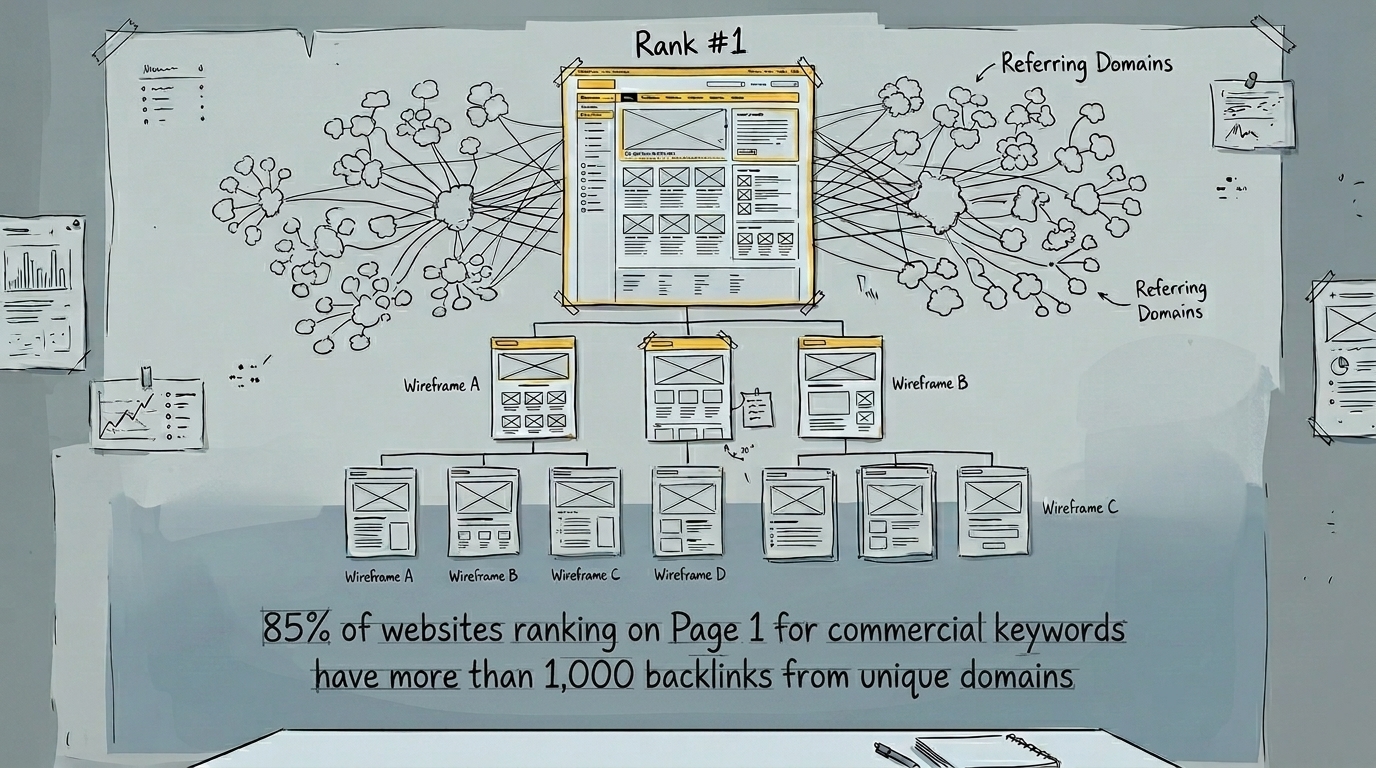
85% of websites ranking on Page 1 for commercial keywords have more than 1,000 backlinks from unique domains. The page in the #1 spot typically has 3.8x more links than pages in positions #2 through #10.[12] And 96.55% of all web pages receive zero search traffic—the primary correlate being a lack of referring domains.[13]
Mueller's standard advice: "Create great content and links will come naturally."
The data: 94% of content fails to secure any external links naturally. The era of organic linking through blogrolls and trackbacks is dead. Social media replaced it with walled gardens—Facebook, LinkedIn, Discord, WhatsApp—where links are no-follow, ephemeral, or invisible to search crawlers.
"Build it and they will come" is statistically a path to obscurity.
Google used to penalize sites for bad links. Then they shifted their rhetoric: they don't penalize bad links anymore, they just "neutralize" them.
This sounds reassuring. It's actually a trap—for Google's benefit, not yours.
Think about the economics. If you buy links and they work, you rank and profit. If Google detects them, they're just ignored—you lose the investment but not the site. The risk is asymmetric. It's now rational to buy links until the marginal cost exceeds the marginal revenue of ranking.
The industry understood this immediately. 46% of SEO professionals spend over $10,000 per year on link building. 91.9% believe their competitors buy links. 78% report positive ROI.[14]
If Google's "neutralization" actually worked—if bought links truly had no effect—the ROI would be zero and the industry would collapse. The fact that link building is thriving proves Google's filters are permeable.
Why does Google lie?
Because transparency would break their system.
If Mueller openly admitted "links are the most important factor and site authority determines your ranking ceiling," the flood of link spam would overwhelm their systems. By telling the masses to "focus on content," Google reduces the noise in the signal they still depend on.
The rhetoric protects Google's operational efficiency. It does not protect publishers.
Meanwhile, the API leaked a smallPersonalSite flag—a specific classification that treats small sites differently.[8] Mueller champions the independent web while the algorithm literally has a tag that identifies and constrains it.
Where This Leaves Us
The future isn't better detection. It's entity verification at scale.
Google has given up on evaluating content directly. Their new approach: verify the source, trust the output. If you're a Known Entity—a brand with presence across the Knowledge Graph—you can publish whatever you want, AI or human. If you're an Unknown Entity, even your best human-written content is suspect.
This creates a bifurcated web.
The Digital Goliaths: Dotdash Meredith. Hearst. Future PLC. Red Ventures. They use AI at scale, license their content to OpenAI and Perplexity, and dominate search results because they are Better Homes & Gardens and you are not.
Everyone else: Treated as a disconnected entity by default. Recovery requires either going viral (the HouseFresh path)[4] or spending six figures on brand rehabilitation (the DMARGE path).[3]
The smartest publishers have noticed. Future PLC now calls it the "Google Zero" strategy—building a business model that assumes zero referral traffic from Google Search. They've diversified into newsletters, apps, social commerce. By 2025, only 27% of their sessions came from Google.[15]
The irony: by reducing dependence on Google, they build the direct traffic signals that Google's algorithm interprets as brand authority. Which helps them rank higher in search.
The best way to rank in Google is to not need Google.
The "Helpful Content Update" was a misnomer. It was a Credible Brand Update. Entity over content. Verification over detection. Brand over keywords.
Google didn't figure out AI. They figured out that figuring out AI is impossible—and retreated to the only signals they could still trust: massive brands with undeniable real-world presence.
For independent creators, the lesson is simple: You cannot SEO your way out of a branding problem.
The old playbook—find keywords, write content, build some links, wait for traffic—is dead. Not because AI ruined it. Because Google decided the only content worth trusting comes from entities too big to fake.
The winners now are people who become brands—not just make good content, but build something recognizable enough that Google's systems can verify they exist. People who don't need Google at all: email lists, direct audiences, revenue streams that don't evaporate when an algorithm changes. People who use AI strategically, as infrastructure rather than replacement—because the same AI content that kills a niche blog makes a major publisher more profitable.
And people who actually know things. Subject matter expertise is one of the few signals still hard to fake at scale. But expertise alone isn't enough anymore. You need the entity signals to prove you're worth listening to.
I'm still rebuilding from September. The nuked site stays dead. New projects now, with everything I learned. Different approach. More brand-building. More direct audience. Less dependence on an algorithm that decided I don't exist.
This isn't about AI versus humans. It's about known versus unknown. Big versus small. Verified versus invisible.
I'm working on becoming visible.
References
- Reboot Online Marketing Ltd. (2024, March). AI vs. human content: A long-term SEO experiment tracking 68 websites. Reboot Online.
- Hardaker, M. (2024, October 30). Google Web Creator Summit: A publisher's perspective. Mountain Weekly News. https://mtnweekly.com/seo/google-web-creator-summit/
- Wiesman, L. (2025, May 10). My 3-year $200,000++ Google helpful content recovery journey is a quiet warning for news publishers everywhere. Medium.
- Navarro, G. (2024, February 14). How Google is killing independent sites. HouseFresh. https://housefresh.com/david-vs-digital-goliaths/
- AIOSEO. (2023, October 31). How Krispcall.com grew organic traffic by 1,969% YoY. AIOSEO Case Studies. https://aioseo.com/how-krispcall-com-grew-organic-traffic/
- Schwartz, B. (2024, September 5). Google issues manual actions for site reputation abuse. Search Engine Roundtable. https://www.seroundtable.com/google-site-reputation-abuse-manual-actions-37151.html
- Fishkin, R. (2024, May 27). An anonymous source shared thousands of leaked Google Search API documents with me. SparkToro. https://sparktoro.com/blog/an-anonymous-source-shared-thousands-of-leaked-google-search-api-documents-with-me-everyone-in-seo-should-see-them/
- King, M. (2024, May 27). Secrets from the algorithm: Google Search's internal engineering documentation has leaked. iPullRank. https://ipullrank.com/google-algo-leak
- U.S. District Court for the District of Columbia. (2024). U.S. v. Google LLC, 1:20-cv-03010. United States Department of Justice.
- Google Search Central. (2022, January 28). English Google SEO office hours from January 28, 2022 [Video]. YouTube. https://www.youtube.com/watch?v=cKibq_y5Y5c
- Schwartz, B. (2023, September 22). Google's Gary Illyes: Links are not a top 3 ranking factor. Search Engine Roundtable. https://www.seroundtable.com/google-links-not-a-top-three-ranking-factor-36098.html
- Dean, B. (2024, January 10). We analyzed 11.8 million Google search results: Here's what we learned about SEO. Backlinko. https://backlinko.com/search-engine-ranking
- Ahrefs. (2023, August 3). 96.55% of pages get no search traffic from Google (Here's why). Ahrefs Blog. https://ahrefs.com/blog/search-traffic-study/
- Kovács, G. (2024, February 2). Link building statistics: We surveyed 700+ SEO professionals. Authority Hacker. https://www.authorityhacker.com/link-building-statistics/
- Future plc. (2025, December 4). Final FY 2025 results. Future plc Investor Relations. https://www.futureplc.com/investor-results/
Mochi Nguyen writes about AI, product development, and where technology meets content strategy.
Comments (0)
No comments yet. Be the first to share your thoughts.